Elevated Spine Group

Elevated Spine GroupElevated Spine GroupElevated Spine Group
  • Home
  • About
  • For Attorneys
  • For Providers
  • For Patients
  • Conditions
    • Annular Tear
    • Compression Fracture
    • Degenerative Disc Disease
    • Disc Herniation
    • Failed Back Syndrome
    • Pinched Nerve
    • Sciatica
    • SI Joint Dysfunction
    • Spinal Foraminal Stenosis
    • Spinal Facet Disease
    • Spinal stenosis
    • Spondylolisthesis
  • Procedures
    • ACDF
    • Cervical Disc Replacement
    • Kyphoplasty
    • MIS Laminotomy
    • MIS Foraminotomy
    • MIS Microdiscectomy
    • PRP Injection
    • Spinal Thermal Ablation
    • TLIF
  • Contact
  • More
    • Home
    • About
    • For Attorneys
    • For Providers
    • For Patients
    • Conditions
      • Annular Tear
      • Compression Fracture
      • Degenerative Disc Disease
      • Disc Herniation
      • Failed Back Syndrome
      • Pinched Nerve
      • Sciatica
      • SI Joint Dysfunction
      • Spinal Foraminal Stenosis
      • Spinal Facet Disease
      • Spinal stenosis
      • Spondylolisthesis
    • Procedures
      • ACDF
      • Cervical Disc Replacement
      • Kyphoplasty
      • MIS Laminotomy
      • MIS Foraminotomy
      • MIS Microdiscectomy
      • PRP Injection
      • Spinal Thermal Ablation
      • TLIF
    • Contact

Elevated Spine Group

Elevated Spine GroupElevated Spine GroupElevated Spine Group
  • Home
  • About
  • For Attorneys
  • For Providers
  • For Patients
  • Conditions
    • Annular Tear
    • Compression Fracture
    • Degenerative Disc Disease
    • Disc Herniation
    • Failed Back Syndrome
    • Pinched Nerve
    • Sciatica
    • SI Joint Dysfunction
    • Spinal Foraminal Stenosis
    • Spinal Facet Disease
    • Spinal stenosis
    • Spondylolisthesis
  • Procedures
    • ACDF
    • Cervical Disc Replacement
    • Kyphoplasty
    • MIS Laminotomy
    • MIS Foraminotomy
    • MIS Microdiscectomy
    • PRP Injection
    • Spinal Thermal Ablation
    • TLIF
  • Contact

Disc Herniation

Discs are the soft cushions between each of the vertebrae (bones) that allow for your body’s movements. A disc herniation occurs when the “jelly” (nucleus pulposus) inside one of your spinal cushions actually squeezes out through a weak spot or tear in the outer shell (annulus fibrosus). Imagine sitting on a jelly donut, with enough pressure, some of the filling escapes. That “escaped jelly” can push on your spinal nerves, which is why the pain often feels sharp, burning, or even shoots down your arm or leg.


If it’s in your neck, it could mean:

·  Pain or tingling going into your shoulder or arm

·  Sometimes weakness in your arm or grip


If it’s in your lower back, you might notice:

·  Pain that runs down your leg (sciatica)

·  Tingling, numbness, or weakness in the foot or calf


It usually shows up because of strain like trauma, heavy lifting, twisting wrong, or even just an unlucky movement.


The good news is that most herniated discs get better without surgery. 


Doctors usually start with:

·  Rest (but not too much) and gentle walking

·  Anti-inflammatory meds for swelling - not meant to be used long-term as they

can cause harm to major organs over time.

·  Physical therapy to rebuild strength and take pressure off the disc

·  In some cases, injections to calm the nerve irritation

·  Surgery is the last option and only considered if the pain won’t let up or if there’s

serious nerve pressure and potential for permanent nerve injury.
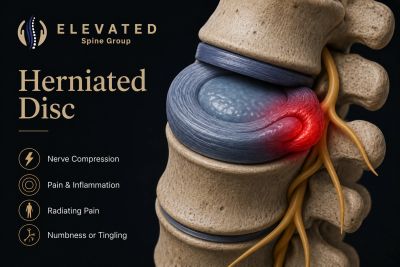
3D illustration of a herniated disc causing nerve compression and pain.
Contact us

Copyright © 2026 Elevated Spine Group - All Rights Reserved.

Created by M2 Marketing Strategies

This website uses cookies.

We use cookies to analyze website traffic and optimize your website experience. By accepting our use of cookies, your data will be aggregated with all other user data.

Accept