Elevated Spine Group

Elevated Spine GroupElevated Spine GroupElevated Spine Group
  • Home
  • About
  • For Attorneys
  • For Providers
  • For Patients
  • Conditions
    • Annular Tear
    • Compression Fracture
    • Degenerative Disc Disease
    • Disc Herniation
    • Failed Back Syndrome
    • Pinched Nerve
    • Sciatica
    • SI Joint Dysfunction
    • Spinal Foraminal Stenosis
    • Spinal Facet Disease
    • Spinal stenosis
    • Spondylolisthesis
  • Procedures
    • ACDF
    • Cervical Disc Replacement
    • Kyphoplasty
    • MIS Laminotomy
    • MIS Foraminotomy
    • MIS Microdiscectomy
    • PRP Injection
    • Spinal Thermal Ablation
    • TLIF
  • Contact
  • More
    • Home
    • About
    • For Attorneys
    • For Providers
    • For Patients
    • Conditions
      • Annular Tear
      • Compression Fracture
      • Degenerative Disc Disease
      • Disc Herniation
      • Failed Back Syndrome
      • Pinched Nerve
      • Sciatica
      • SI Joint Dysfunction
      • Spinal Foraminal Stenosis
      • Spinal Facet Disease
      • Spinal stenosis
      • Spondylolisthesis
    • Procedures
      • ACDF
      • Cervical Disc Replacement
      • Kyphoplasty
      • MIS Laminotomy
      • MIS Foraminotomy
      • MIS Microdiscectomy
      • PRP Injection
      • Spinal Thermal Ablation
      • TLIF
    • Contact

Elevated Spine Group

Elevated Spine GroupElevated Spine GroupElevated Spine Group
  • Home
  • About
  • For Attorneys
  • For Providers
  • For Patients
  • Conditions
    • Annular Tear
    • Compression Fracture
    • Degenerative Disc Disease
    • Disc Herniation
    • Failed Back Syndrome
    • Pinched Nerve
    • Sciatica
    • SI Joint Dysfunction
    • Spinal Foraminal Stenosis
    • Spinal Facet Disease
    • Spinal stenosis
    • Spondylolisthesis
  • Procedures
    • ACDF
    • Cervical Disc Replacement
    • Kyphoplasty
    • MIS Laminotomy
    • MIS Foraminotomy
    • MIS Microdiscectomy
    • PRP Injection
    • Spinal Thermal Ablation
    • TLIF
  • Contact

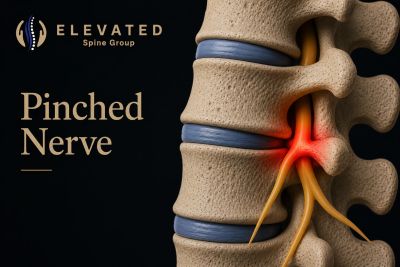
Pinched Nerve

A pinched nerve simply means a nerve is being squeezed too tightly by something nearby often a herniated disc, a bone spur, spinal stenosis, or even poor posture and repetitive strain.


When that happens, the nerve can’t send signals smoothly, and you may notice:

·  Sharp or burning pain in your back or neck 

·  Radiating pain, like sciatica shooting down your leg or aching into your arm

·  Tingling or numbness (like your hand or foot “falling asleep”)

·  Muscle weakness in the area that nerve controls


Pinched nerves happen most often in the neck or lower back, since those areas take the most movement and load.


How doctors figure it out:

·  A physical exam (testing strength, reflexes, and sensation)

·  Imaging like an MRI or CT scan to see what’s pressing on the nerve

·  Sometimes nerve conduction studies to check how well signals are traveling


Treatment usually starts simple:

·  Rest and posture changes to take pressure off

·  Anti-inflammatory meds to reduce swelling

·  Physical therapy to stretch, strengthen, and realign your body

·  Steroid injections if pain lingers

·  Surgery is considered if symptoms are not improving or keep getting worse


One important thing: if a nerve stays compressed too long, it can cause permanent damage. That’s why getting checked and treated early matters.like foraminotomy can widen the opening so the nerve can glide freely again
Contact us

Copyright © 2026 Elevated Spine Group - All Rights Reserved.

Created by M2 Marketing Strategies

This website uses cookies.

We use cookies to analyze website traffic and optimize your website experience. By accepting our use of cookies, your data will be aggregated with all other user data.

Accept